The Irish Polling Indicator, a project launched in 2014 and maintained by Stefan Müller, combines all Irish opinion polls for the Dáil Éireann into ranges of likely support.
The Guardian, the Financial Times, the Irish Times, RTÉ News, Sky News, the Irish Independent, the Sunday Times, the Business Post, and Reuters all reported estimates from the Irish Polling Indicator. Read more in our media coverage section.
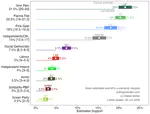
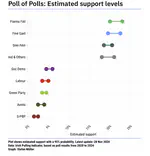
Current levels of party support according to the Irish Polling Indicator
Note: The Irish Polling Indicator only includes parties consistently tracked by all pollsters. A note on the Bayesian credible intervals: If all of the assumptions of our model hold, then there is a 95% probability that a party’s support is within the range of the 95% uncertainty margins.
Opinion polls are subject to a degree of uncertainty. In principle, polls reflect public opinion at the time of the survey and do not constitute predictions of election results. The Polling Indicator aims to complement the work of pollsters by contextualising new polls and observing trends over time.
Graphs and Tables
Change in party support since the last general election
Note: This graph displays the development of party support in the Polling Indicator over time since the last elections. The shaded areas indicate the 95% uncertainty margin. Hover over or tap a line to see the party's estimate on that date. Select one or more parties to show only them.
Individual polling results and Irish Polling Indicator estimates for Fianna Fáil
Note: The line displays the Polling Indicator estimate with the 95% uncertainty margin shaded. Dots indicate the polls. Mouseover to see exact values. The polls are plotted in the (middle of the) fieldwork period, not the publication date.
Select party:
Select pollsters:
House effects: how each pollster differs from the average
Note: The graph displays the house effects of the polling companies for each party. A positive house effect means that a pollster structurally estimates a certain party higher than the average pollster. The dot indicates the best estimate for the house effect (measured as percentage point differences), the lines display 95% uncertainty margins.
Party support in general elections and opinion polls, 1987 to 2026
Time runs from top to bottom. Each block covers the period between two general elections, and the width of each colour shows a party's share of support in that month. Hover over or tap an election to see its result. Select one or more parties to follow their support over time. Click or tap a government on the right to follow the support of the cabinet parties.
Note: Each row of the chart shows the monthly average of the Irish Polling Indicator estimates, with party shares rescaled to add up to 100%. White gaps mark general elections. The chart only shows parties that polls reported consistently and that the Irish Polling Indicator included at the time; all other parties count towards Independents/Others. With one to four parties selected, their latest estimates and 95% uncertainty margins follow the last block. Sources: Irish Polling Indicator (monthly polling estimates); ParlGov (first-preference vote shares and seat shares).
Note: The table lists party support in the most recent opinion polls. The table is updated automatically when new polls are published. Numbers show first-preference vote intentions (%). FF: Fianna Fáil; FG: Fine Gael; SF: Sinn Féin; SD: Social Democrats; LAB: Labour Party; AU: Aontú; II: Independent Ireland; GP: Green Party; PBP: Solidarity-People Before Profit; I/O: Independents and other parties.
Validating the Irish Polling Indicator
The Irish Polling Indicator can only be as accurate as the opinion polls it aggregates. Overall, Irish opinion polls have a good track record. They are quite accurate and perform at least as well as, and often better than, polls in other countries.
The graph below compares first-preference vote shares in the 2024 General Election with the Irish Polling Indicator estimates released the day before the election.
On average, the election results deviated by less than 0.6 percentage points from the Polling Indicator estimate. With the exception of the Green Party and Solidarity-PBP, the Irish Polling Indicator estimates were within the margin of error.
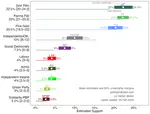
Difference between Irish Polling Indicator estimates and 2024 general election results
Note: Light bars show first-preference vote shares. Dots and horizontal lines in the same colour show the Irish Polling Indicator estimates and their 95% uncertainty margins.
Comparing Vote-Poll Errors Since 1989
To assess the accuracy of polls more systematically, we can calculate the vote-poll error. If the election result matches the polls exactly, the vote-poll error is zero. For example, a vote-poll error of 1 would mean that, on average, the polls were off by one percentage point from the election results across all parties and Independents.
The figure below shows polling errors for Irish general elections from 1989 to 2024. Across these nine elections, the estimates were off by 1.24 percentage points from actual first-preference vote shares. This vote-poll error is considerably better than the errors observed in a comparative study of over 30,000 opinion polls from 350 elections in 45 countries.
The Irish Polling Indicator achieved a vote-poll error of 0.54 in the 2024 General Election, its most accurate result yet.
Vote-poll errors in Irish general elections, 1989–2024
Method
The basic idea of the Irish Polling Indicator, launched in 2014, is to take all available polling information together to arrive at the best estimate of current support for parties. Polls are great tools for measuring public opinion, but because only a limited sample is surveyed, we need to take into account sampling error. By combining multiple polls, we can reduce this error.
Moreover, with so many polls going around it is difficult to get a random sample of voters to participate in any one public opinion survey. And those that do participate might not have a clear idea who to vote for, something that is often adjusted for in polls. This may lead to structural differences between the results of different polling companies, so-called house effects.
The Irish Polling Indicator considers sampling error and house effects when aggregating support for Irish parties.
Estimates from the Irish Polling Indicator and associated research have been covered by a wide range of Irish and international news outlets. Click on the logos below to read some of the media coverage.
Irish News Outlets
International News Outlets and Websites
Datasets
Irish Polling Indicator
We provide full access to all available polling results (1982–2026) and daily aggregated estimates (1987–2026). A detailed codebook describes both datasets and all variables.
Development Version (Latest Data Release)
First, we release our datasets as a development version which is updated after the release of every poll and stored in a GitHub repository.
Second, we provide a stable version of the daily estimates and raw polling results. New releases are published after an election cycle. The stable version has a unique identifier (DOI: 10.7910/DVN/8YVVYX).
If you use the stable version in your work, please consider citing:
Tom Louwerse and Stefan Müller. 2025. Irish Polling Indicator Datasets: Stable Version (1987–2024). Harvard Dataverse. DOI: 10.7910/DVN/8YVVYX
In addition to the Irish Polling Indicator data, the Irish Demographic Polling Datasets collect results on vote intentions, satisfaction with the government, and popularity of party leaders. The polling results are available for all respondents and various subsamples, such as age groups, gender, social class, geographic region, and district magnitude. The database merges over 100 polls, published between 2011 and 2025. The datasets can be accessed, visualised, and downloaded through an interactive dashboard.
Stefan Müller is an Associate Professor in the School of Politics and International Relations at University College Dublin. Stefan’s research focuses on political representation, party competition, political communication, public opinion, and quantitative text analysis. Website | CV | BlueSky
Founding Member
Tom Louwerse is Professor in Political Science at Leiden University, the Netherlands. Tom’s research and teaching focuses on elections, political representation and parliamentary politics in the Netherlands and other established democracies. Website | BlueSky
The Polling Indicator was selected as a finalist and runner-up for the 2025 UCD Impact Case Study Competition. You can read more about the project, testimonials, and its impact on the UCD website.
Contact
Please do not hesitate to contact us if you have any questions about the project or if you would like to include our estimates in reports or articles. If you refer to our data, please mention the Irish Polling Indicator, its maintainer, Stefan Müller, and ideally include a link to this website. Feel free to use the data in your academic work, and please consider citing the Irish Polling Indicator data.
You can follow the Irish Polling Indicator on BlueSky.